Impression of Dick Sanderman about Volume 1:
Salisbury Cathedral geldt als een van de belangrijkste voorbeelden van vroeg-Engelse architectuur.
Terwijl de meeste oude kathedralen een bouwgeschiedenis van honderden jaren kennen,
ontstond de kathedraal van Salisbury binnen een tijdsbestek van slechts 38 jaar, van 1220 tot 1258.
De kathedraal heeft de hoogste kerktoren van heel Engeland: 123 meter hoog. De 'cloisters',
de kloostergangen bij de kathedraal, zijn de grootste van Engeland, en ook het grondoppervlak van de 'close',
het terrein rondom de kathedraal, is nergens in Engeland zo groot als in Salisbury.
En alsof dat nog niet genoeg superlatieven zijn,
heeft Salisbury Cathedral ook nog een van de drie bekendste Willis-orgels binnen haar muren.
Willis is een Engelse orgelbouw-dynastie, begonnen met 'Father' Henry Willis (1821-1901) en voortgezet tot op de dag van vandaag.
Father Willis bouwde of verbouwde orgels voor veel Britse kathedralen.
Instrumenten die ook nu nog getuigen van zijn meesterschap,
zijn bijvoorbeeld de orgels van de Royal Albert Hall in Londen en van de kathedralen in Truro en - inderdaad:
Salisbury. Willis was een innovatief man.
Tot de vindingen waarmee hij de orgelbouw vooruit hielp, behoren de duimpistons, de pneumatische registertractuur,
het radiaal-concaaf pedaalklavier en de buizenpneumatiek.
We kennen in Nederland een Willis-orgel in Amersfoort (Emmakerk, 1875, afkomstig uit Blackburn),
terwijl de Hooglandse kerk in Leiden een kathedraalorgel krijgt waarin een Willis-orgel uit 1892 (afkomstig uit Birkenhead) als uitgangspunt fungeert,
met uitbreiding door de tegenwoordige firma Henry Willis & Sons uit Liverpool.
Het orgel van Salisbury Cathedral is gebouwd in 1877. Hoewel er door de jaren heen wel aan het orgel is gewerkt,
is het oorspronkelijke Willis-karakter zeer goed bewaard gebleven:
een karakter dat zich kenmerkt door een zeer verfijnde intonatie,
voortreffelijke versmelting van de stemmen en een groot dynamisch bereik,
mede dankzij de effectieve zwelkasten. Momenteel heeft het orgel 65 stemmen, verdeeld over vier klavieren en pedaal.
De Anglicaanse liturgie stelt bijzondere eisen aan het orgel,
zeker in kathedralen, waar dagelijks diensten worden gehouden en waarin het koor een groot aandeel heeft.
In die liturgische praktijk is een kerkmuzikaal repertoire ontstaan waarbij het orgel vaak orkestraal wordt behandeld - en waar de orgelmakers hun instrumenten dan ook helemaal op hebben ingericht.
Snelle registerwisselingen kunnen worden gerealiseerd via de vrije combinaties,
crescendo en diminuendo zijn dankzij de aanwezigheid van zwelkasten geen enkel probleem, orkestrale solostemmen als hobo,
klarinet en trompet zijn ruimschoots voorhanden, enzovoort.
Het is een orgeltype dat voor een specifieke liturgie is gemaakt en waar je -als je er niet vertrouwd mee bent- echt mee moet leren omgaan.
Milan Digital Audio gaat het Willis orgel van Salisbury in drie afleveringen uitbrengen.
Volume 1 (Wet Version) is verschenen, met 28 stemmen verdeeld over vier manualen en pedaal.
De registers van Solo (manuaal IV), de tongwerken van Swell en Choir en de Vox Angelica zijn opgenomen met de OST-methode (Original Sampled Tremulants),
zodat deze registers met tremulant even natuurgetrouw klinken als zonder.
Een groot winstpunt ten opzichte van sets waar de tremulant een softwarematige verandering van de gesamplede toon bewerkstelligt.
Het ligt in de bedoeling, ook een Dry en een Surround-versie uit te brengen.
De 28 stemmen die in Volume 1 beschikbaar zijn, geven al veel mogelijkheden voor het spelen van muziek die bij dit orgeltype past.
Op het Swell is een stevig plenum beschikbaar, en juist dat 'Full Swell' is een essentiele klank in de Engelse orgelmuziek.
Ook op Great kan een plenum worden gebouwd.
Van Solo zijn alleen maar twee fluiten en de belangrijke solostem Clarinet beschikbaar, van Choir nog niets.
Ook het pedaal is met drie labiale zestienvoeten, een 32', een 8' en de Ophicleide 16' al goed bezet.
De typisch Engelse hogedruktongwerken zijn nog niet aanwezig, maar de Trumpet van Great heeft genoeg allure om voorlopig als alternatief te fungeren in situaties waar eigenlijk een Tuba nodig zou zijn.
Van de vier klavieren zijn er twee zwelbaar: Solo en Swell.
De zwelkast om het Swell reageert nogal indirect: dat zal in 't echt ook zo zijn, maar daarom is het nog wel lastig.
Een Generaal Crescendo, op dit orgeltype vaak een zeer bruikbare voorziening, is in Salisbury niet aanwezig.
Deze Wet-versie klinkt flink ruimtelijk. Wie wel eens een Evensong heeft meegemaakt in een Engelse kathedraal,
weet dat je dan als regel een plekje krijgt in het koor van de kerk, dichtbij het orgel.
Wat Salisbury-Wet nu biedt, is eerder de klank zoals je het orgel hoort in het schip van de kerk,
dus op grotere afstand van het orgel. Wie kritisch naar zichzelf wil luisteren tijdens het studeren,
kan beter een droge set gebruiken (bijvoorbeeld 1901, J.J. Binns, Haverhill).
Salisbury-Wet is echter bij uitstek geschikt om even weg te dromen en jezelf in een Engelse kathedraal te wanen.
Een paar opmerkingen over de registratie:
Op dit orgeltype is registreren echt het mengen van kleuren.
Vaak koppelt men alles manualen en stapsgewijs registers toe om een mooi registercrescendo te bereiken.
De Vox Angelica (Swell) zweeft ten opzichte van de Viola da Gamba. Het is een bescheiden zweving, die kan worden geintensiveerd door het toevoegen van de tremulant.
De Vox Angelica is ook met OST-technologie opgenomen.
Een heel belangrijke registratie is die waarbij het 'Full Swell' (plenum van het zwelwerk, met Mixtuur en tongwerken) gekoppeld wordt aan een paar grondstemmen van het Great.
Met de zwelkast dicht klinkt er dan een klank waarin die grondstemmen van Great het beeld bepalen, maar het timbre van dat zwelwerkplenum schemert er al wel doorheen.
Gaat vervolgens langzamerhand de zwelkast open, dan ontvouwt zich een grootse orgelklank - want 'Full Swell' is echt een indrukwekkend plenum.
Nog effectiever wordt het als daarbij ook de super- en suboctaafkoppels van Swell naar Great nog worden toegevoegd.
Octaafkoppels zijn op dit soort orgels in ruime mate voorhanden.
Wie er creatief gebruik van maakt, vergroot daarmee de registratiemogelijkheden enorm.
In het praeludium van Buxtehude heb ik veelvuldig gebruik gemaakt van octaafkoppels om te illustreren dat op zo'n op en top romantisch orgel ook barokmuziek gespeeld kan worden.
De speelhulp Great Reeds on Choir maakt de tongwerken van Great speelbaar op Choir. In Volume 1 betreft dat alleen de Trumpet.
Omdat de Tuba van Solo nog niet beschikbaar is in deze set,
is het bijzonder handig dat de Trumpet voorlopig als ersatz-Tuba kan fungeren op een ander manuaal dan Great.
A lot other examples from this book can you listen at: Marco den Toom.
Impression of Gert about Volume 1:
The first thing that is noticeable for this English Romantic organ is the appearance: It has two fronts on both sides of the church (I can better say Cathedral).
The reverberation in such a cathedral is of course very long. The position of the microphones is very important:
Or on a great distance with a very long reverb that you don't hear the individual voices, or very close to the organ where the beautiful acoustics lost.
For this sampleset is a good intermediate form chosen, I suspect that the samples are a mix of 'direct' sounds and 'indirect' sound.
The individual voices are clearly audible, even the soft strings.
It is planned that a sampleset is made in three versions:
Wet Edition
Surround Edition
Dry Edition
At first comes the Wet Edition.
This version comes out in three consecutive 'Volumes', now I write, only Volume 1 is available.
The splitting of a large organ in different parts was probably inspired by commercial motives.
As a user I also enjoy, it is very good to learn the organ in parts.
28 stops are much easier to overlook than 65.
The 28 stops (distributed over three keyboards) provide sufficient opportunities for many types of music to play:
Beautiful strings on the Swell.
Powerful principals (and mixture) at both Great and Swell.
Beautiful flutes on all three keyboards, a pity that Volume 1 contains only one Fluit4.
Very nice reeds. The strong and detailed Trompet8 (with beautiful reverb) on the Great, I think is the best Trumpet8 of all samplesets that I currently have.
A major strength of this sampleset is that part of the stops (the three stops on Solo, all reeds and the VoxAngelica8 of Swell) are recorded also with Tremulant.
Technically, it seems quite tricky: for all stops the 'wave' must be in the same place, otherwise you get a strange effect when you combine multiple stops (with tremulant).
The tremulant samples are technically 'at the location' of the 'multiple attack samples', so be sure that you load (the first time) also all 'attack samples'.
Adjust the volume after installation (Menu Organ Settings / General Options / Master level adjust dB) to 10 dB, because it is standard at -10 dB, it is far too low.
The low 'standard volume' is, according to the producer, the result of 'an optimization for 16 bit samples'.
In our church I sometimes get accused of being too much like baroque and contemporary music play.
However, it should because our (1 keyboard) organ is not suitable for romantic music.
But with this sampleset it is, in my opinion, a great pleasure to play 'tear-jerkers' with both Tremulants active.
After the download (handy, that this is possible!) was finished I could hardly stop playing.
But I had to stop because I had to go to the birthday of my grandmother of 92 years (a blessing).
What a 'cathedral' suggests: There is a great reverberation present in this church.
This is also nicely captured in this sampleset.
Nice to hear the difference by keyboard: The Solo manual has the longest reverberation, then the Great, and finally the Swell.
As with the other samplesets of Milan, also the reverb of this sampleset is not entirely 'noise free', that is not bad if you turned 'the wind engine / background sound' on.
But one weakness of this sampleset is, in my opinion, the sound of the 'the wind engine / background sound', it looks more 'noise' than 'church background sound'.
I also think the OpenBass16, OpenDiapason16 and Octava8 of the Pedal are very heavy and very dominant.
With Hauptwerk Advanced it is fortunately possible to lower the volume.
At the Swell are very nice (soft) 'solo' voices (e.g. Trompette8, Hautboy8, ContraFagotto8), however, they must be accompanied by a soft stop.
This is in Volume1 (limited) possible with the FluteHarmonique8 (Solo), StoppedDiapason8 (Gr) or ClaribelFlute8 (Gr).
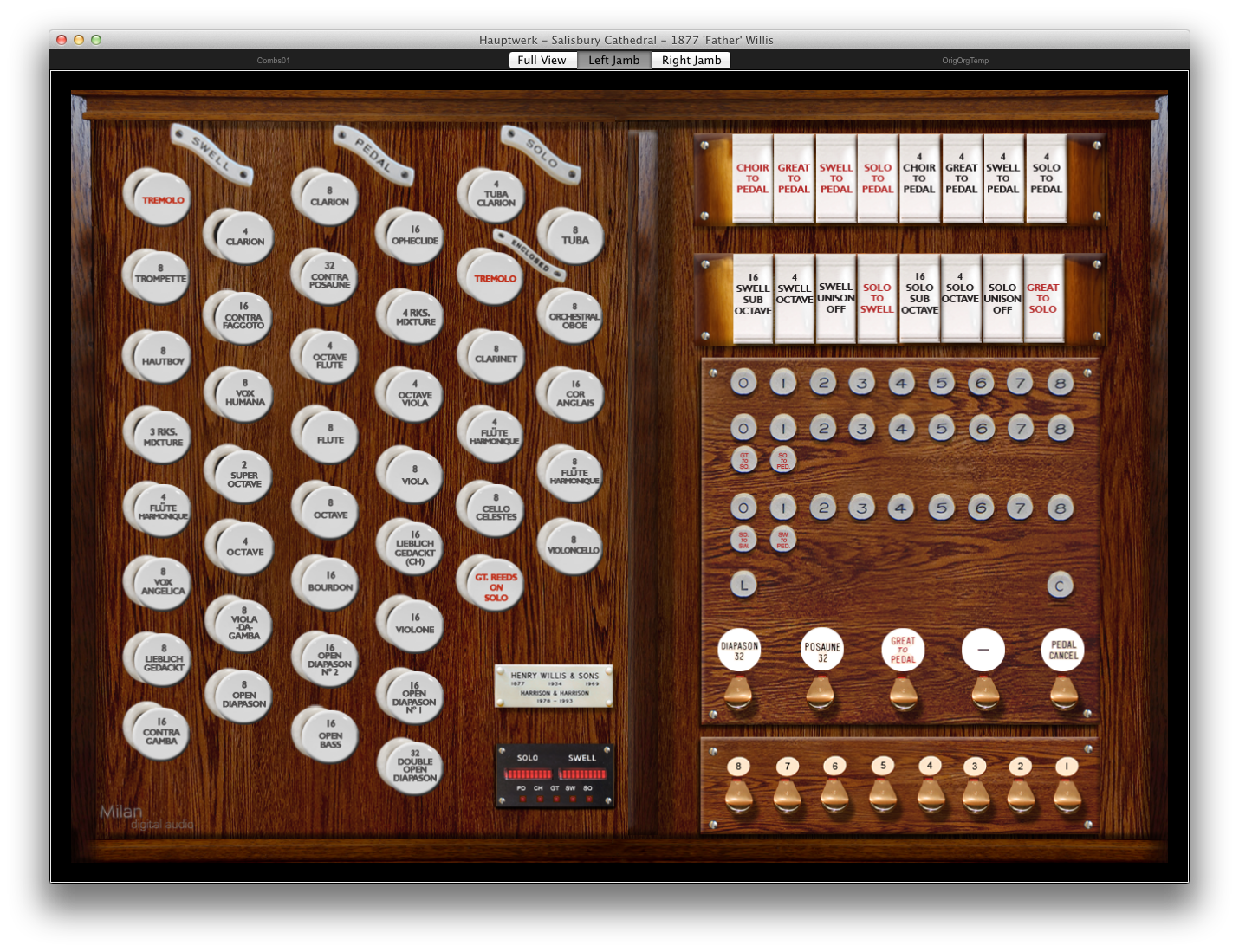
The registration console is a good combination of beautiful, realistic and practical.
As in the original organ, there are 8 general 'combination pistons', and further 8 separately for each keyboard.
I use the latter never.
On this sampleset are many couplers, so it is no problem if you have two keyboards, you can 'couple' almost each keyboard to each other.
For Volume 1 is a computer with 4 GB RAM enough (see requirements).
It is worth to download the free trial version from Instrument Downloads.
Impression of Gert about Volume 2 en 3:
Een ideaal sampleset voor het spelen van muziek waarin de melodie als 'solo' klinkt.
Hiervoor zijn erg veel mogelijkheden op dit orgel.
Persoonlijk vind ik het prachtig om daarbij de tremulant te gebruiken, die erg goed klinkt bij deze sampleset omdat de meeste (alles van Solo, alle tongwerken en VoxAng van Swell) registers ook met tremulant zijn opgenomen.
De hogedruk tongwerken Tuba 8 en Tuba Clarion 4 completeren dit grote Kathedraal orgel.
Deze Tuba is zo krachtig dat hij begeleid kan worden met het (bijna) volle werk van Great en Choir samen.
Deze sampleset vind ik het mooiste met hoofdtelefoon, via speakers iets minder omdat de klank vrij 'indirect' (niet dicht bij het orgel) is opgenomen.
Hierdoor gaan de details van de afzonderlijke stemmen verloren.
Door de indirecte opname 'mengen' de registers wel heel goed samen en opnames lijken net 'cd opnames'.
Als geluidsdemo heb ik zowel de Baroque Suite als de Cathedral Suite (behalve de 2 Toccata's, die vind ik te moeilijk) van amerikaan Gordon Young opgenomen.
Deze muziek klinkt als een klok op dit orgel.
De geluiden van de windmotor en van de tremulantmotors zijn ook opgenomen, op zich mooi, maar ik vind ze veel te overheersend klinken. Met Hauptwerk Advanced kun je het volume daarvan gelukkig eenvoudig reduceren.
Bij mij in huis klinken de pedaalregisters ook te hard, ook die kun je met Hauptwerk Advanced corrigeren (bij de opnames hieronder heb ik het volume van pedaalregisters niet aangepast).
De layout van de verschillende schermen vind ik zowel realistisch, mooi en praktisch, ik mis de 'foto realistische manualen' (waarbij je toetsen naar beneden ziet gaan) niet.
Bij deze sampleset bestaat ook de mogelijkheid om de schermen verticaal te plaatsen.
Organorak heeft dit gedaan, zie de foto van zijn orgel waarbij de sampleset bijzonder goed met het orgel integreert.
De sterkste punten vind ik:
De opgenomen tremulanten.
De prachtige strijkers op vrijwel ieder manuaal en pedaal.
De mooie harde en zachte tongwerken op ieder manuaal en pedaal.
Een krachtige hogedruk Tuba.
De mooie akoestiek van de kerk.
Erg geschikt voor het maken van opnames, het klinkt 'cd realistisch'.
Minder goede punten:
Vooral geschikt voor hoofdtelefoon, minder geschikt voor speakers omdat de sampleset (nog) niet in surround is opgenomen, bovendien zijn de registers niet van dichtbij opgenomen.
Minder geschikt voor barokmuziek vanwege minder gedetailleerde fluiten en prestanten.
Met ongeveer E 850,- voor de complete sampleset behoort deze wel bij de top drie van de duurste Hauptwerk sets.