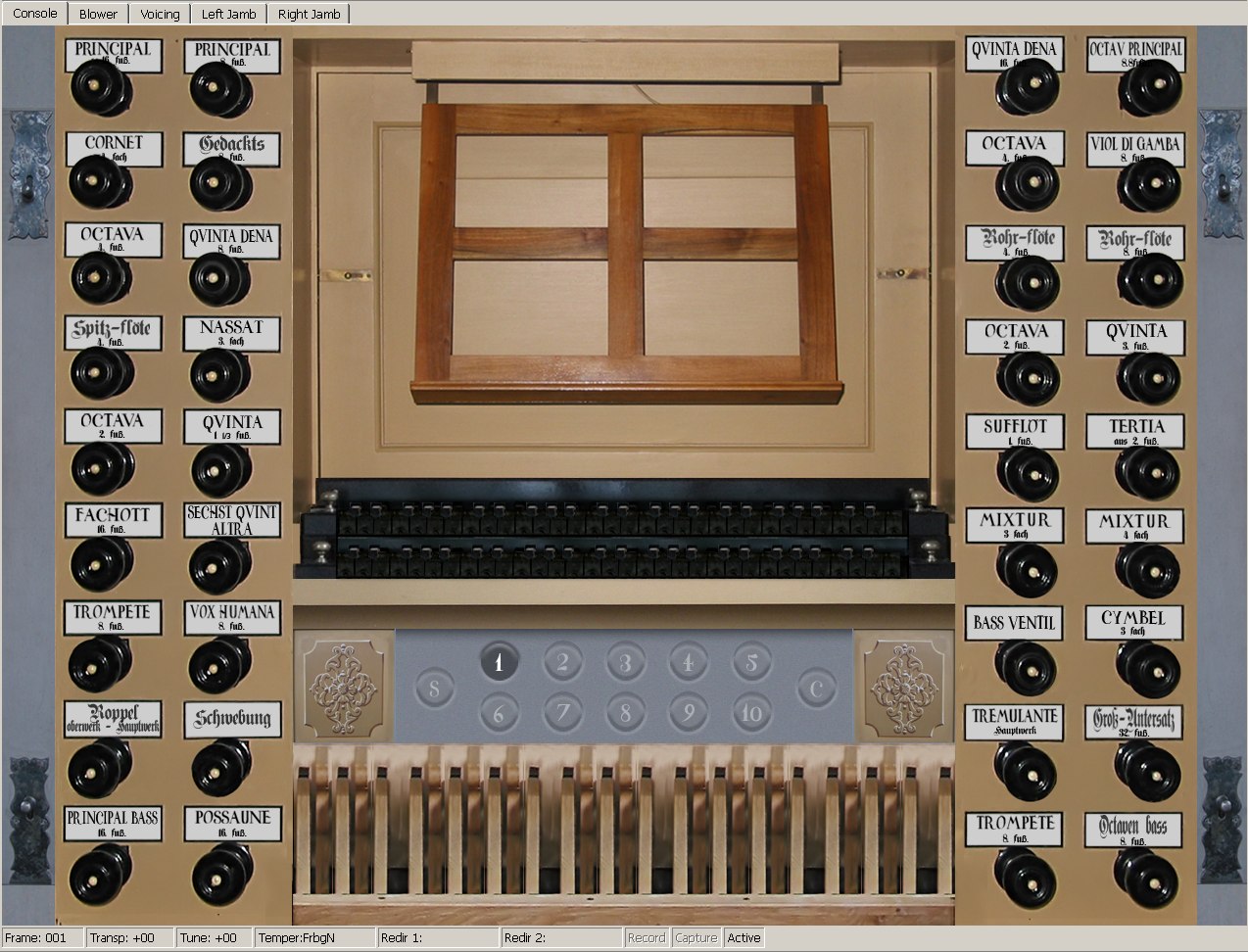
Silbermann build during his live (1683-1753) about 50 organs.
With 32 stops, this is one of the biggest (and the biggest 2 manual organ) which he build.
What strikes of this beautiful baroque organ, is the symmetry in the disposition of both manuals (Principal 8, 4 and 2, Flute 8 and 4, Mixture, reed).
This is a splendid organ to make nice principal plenums.
The principals sounds quite warm, I prefer the Octav-Principal 8 of the Hauptwerk over the Principal 8 of the Oberwerk.
The flutes are very clear; I like especially the Rohrflutes 8 and 4, the Spitz Flote 4 sounds a bit less in my personal opinion.
The Viola di Gamba is also very warm and can be combined with the Rohrflute 8.
The, a bit loud, Trumpet is a real rasping baroque reed. The nice, and not too soft (volume), Vox Humana vibrates as usual.
The stately Fagot 16 is uncomfortable slow, the Trumpet a bit less.
When you complete the Cornet (4 fach) with the Octav-Principal 8 (and/or Rohrflute 8) you have a magnificent solo registration.
Also with the aliquots you can compose nice solo registrations.
It is hard to find disadvantages of this organ, but I shall name a few:
A pity that the disposition does not contain a 2 feet flute.
May be I'm to much a pragmatist, but it's unpleasant that this sampleset does not contain an Oberwerk-Pedal coupler (also not available on the original organ).
The church has ideal acoustics (about 3-4 seconds reverb) for practical (study) usage.
There is enough reverb for nice and not too much so you lose the details.
Sonus Paradisi publishes this sampleset in two versions:
The front channels are 'direct', ORTF stereo recorded on a few meters from the organ.
The front channels contain high portion of the direct sound which stands out well from the reverberation. Also, the location of pipes is well defined.
The sound is pristine, clear, present, extremely well suitable for a solo use of the stops.
The front channels are 'diffuse', AB stereo recorded from the church nave. The front channels contain well balanced level of the direct and diffused sound, so the stops blend together perfectly and the organ is immersed more deeply into the reverberation.
It performs best in various plenum settings.
Even though I was already very enthusiastic about the Surround version of Zwolle, is that increased now. It is a tremendous improvement of the spacial feeling. You experience that (a part of) the reverb reflections come from behind.
Furthermore you can dose the amount of reverb somewhat through changing the volume of the rear channels.
There is a free downloadable demo package available:
Unfortunately, the Demo package contains no flutes; listen to the mp3 examples how nice they sound!
The organ has considerable key noises (sound of keys).
Strange that this key noise of the Diffuse version sounds equal to the spuck of the Direct version. I expected that the spuck of the Diffuse versions was a bit less.
When you not like the organ noises you can disable these easily when you load the sampleset.
The absence of noise (also in reverb tail) is one of the characteristics of Sonus Paradisi. It's not needed, as by many other sets, to put on the organ motor to avoid that the noise is annoying.
This sampleset has also a handy 'voicing page' to adjust the brightness of each stop (works also for Hauptwerk Basic).
When you put the slider higher, the tone becomes sharper, when you put the slider lower, the tone becomes darker.
I don't use that feature because I want a result that is as much realistic as possible.
For the most recent samplesets of Sonus Paradisi the wind model is made visual, furthermore the wind pressure can be regulated with adjustments of the valves. This nice toy can only be used with Hauptwerk Advanced and outside the U.S. (because of a patent).
When you load the sampleset in 16 bit compressed with single loops and single attacks it uses 2.6 GB RAM memory.
This can be lowered when you not load all stops or when you choose for a 14 bit quality.
Beside the standard ODF (Organ Definition File), contains the sampleset also a free extended version in which the compass of the manual is extended to 54 (original 49) notes and the pedal to 30 (original 27) notes.
The sum is a qualitative good baroque sampleset for practical usage!
Gert, januari 2009 (in 2012 still my most used set!)
Copy the files to c:\Hauptwerk\HauptwerkUserData\OrganCombinations\OrganID000395\
You can load the in Hauptwerk via menu 'Combinations\Load combinations file...'.
Mp3 examples (created with version 1, there is already a version 2!) of me on Diffuse version 1.03CAUTION:
JW Player goes here
Mp3 examples (created with version 1, there is already a version 2!) of me on Direct version 1.00CAUTION:
JW Player goes here
"Nun danket alle Gott / J.S. Bach/Pierre Gouin" played by Detlef Fenske: