Impression of Dick Sanderman:
In de St. Maria d'Alieto-kerk van de Sloveense havenstad Izola bevindt zich een klein 18e-eeuws orgel,
oorspronkelijk gebouwd voor St. Mauro-kerk in diezelfde plaats. Wie de bouwer is, is niet met zekerheid te zeggen.
Hoogstwaarschijnlijk is het een van de belangrijkste orgelmakers van Venetie,
de Franciscaner frater Petar Nakic (Pietro Nacchini) of diens leerling Francesco Dacci (1712-1784).
Hoe het ook zij: het gaat om een typisch voorbeeld van een Italiaans dorpsorgel,
zoals er door de eeuwen heen talloze zijn gebouwd.
Een klavier, een aangehangen pedaal en een rechtlijnige dispositie met een prestantenkoor ("ripieno") van 8' tot 1',
aangevuld met een viervoets fluit en een kortbekerig tongwerkje.
Laatstgenoemde twee registers en de Prestant (Principale) 8' zijn gedeeld in bas en discant,
waarbij de deling niet ligt tussen b en c zoals wij gewend zijn, ook niet tussen c en cis zoals in Spanje gebruikelijk was,
maar tussen cis en d.
Zoals gebruikelijk in Italie ontbreken de voetmaataanduidingen: die zitten namelijk al in de registernaam verwerkt.
Een Flauto in ottava is een fluit die een octaaf hoger klinkt dan normaal, daar hoef je dus geen 4' meer achter te zetten.
En een Decimanona (negentiende) is een register dat de toon laat horen die je 19 witte toetsen verderop zou verwachten.
Op de laagste C klinkt de toon g1, en daarmee is duidelijk dat het een Quint 1 1/3 is.
(Precies op dezelfde manier noemen de Engelsen een Octaaf 2' een Fifteenth).
Aan dat rechtlijnige basismodel werden vooral in de 19e eeuw vaak effectregisters als trommels en belletjes toegevoegd: zelfs de kerkmuziek sprak in die tijd de muzikale taal van de opera, en daarbij waren allerlei toeters en bellen meer dan welkom.
Veel eerder al werd als bijzonder register de Voce Umana toegevoegd, geen tongwerk Vox Humana,
maar een zwevende prestant 8'. Die zweving was bijzonder geliefd voor de Elevazione,
de instrumentale muziek die werd gespeeld tijdens de elevatie, het omhoog heffen van de hostie.
Tijdens dat sacrale moment zorgde de Voce Umana met z'n zweving dan voor de gewijde sfeer.
Van al die mogelijke extraatjes is in Izola echter weinig te bespeuren: aan "registri di concerto" zoals die toevoegingen werden genoemd,
heeft Izola dus alleen een Flauto (4') en een Tromboncini (8'), beide gedeeld in bas en discant.
Dergelijke orgels hebben altijd een kort octaaf: in het onderste octaaf ontbreken dan de tonen Cis, Dis, Fis en Gis.
In de sampleset zijn die tonen uiteraard wel ingevuld.
Orgels van dit type werden tot ver in de 19e eeuw altijd in middentoon gestemd.
In deze sampleset is wel een stemming aanwezig die wordt aangemerkt als de originele, maar die is verre van middentoon.
Kennelijk heeft het orgel van Izola op enig moment z'n echte originele (middentoon)stemming verloren en biedt de sampleset de stemming die momenteel ter plaatse aangetroffen wordt.
Maar dat lijkt me niet de oorspronkelijke te zijn.
Dankzij de goede akoestiek van de kerk klinkt dit orgeltje bijzonder plezierig.
Er zijn wel wat overeenkomsten met Velesovo: ook daar is de akoestiek heel aangenaam en klinken de registers karaktervol,
zonder dat er heel opvallende aanspraakeffecten of ongelijkmatigheden waargenomen kunnen worden.
In de Isola-set is het vooral het tongwerkje dat een karakteristiek element aan de klank toevoegt.
De drie gedeelde registers bieden enkele mogelijkheden om (letterlijk en figuurlijk) te spelen twee verschillende klankkleuren op een klavier.
Vanwege de voor ons ongebruikelijke deling tussen cis en d is dat wel even oppassen geblazen.
Klaas Bolt toonde tijdens een workshop eens een aardig trucje om dat probleem te hanteren:
hij zette een psalmbriefje rechtop tussen de beide toetsen waar de deling ligt.
Simpel maar doeltreffend: de ene hand moet links van het psalmbriefje blijven, de ander blijft aan de rechterkant.
Voor het stijlgetrouw spelen van oude Italiaanse orgelmuziek is de afwezigheid van de originele middentoonstemming een manco.
Ook een Voce Umana wordt node gemist.
Wil je de 19e-eeuwse Italianen spelen, Padre Davide da Bergamo of Vincenzo Petrali bijvoorbeeld,
dan mis je weer de effectregisters.
Ik hoop dat we nog eens een sampleset krijgen van een echte Serassi met alle feestartikelen erop en eraan!
Er blijft echter genoeg muziek over die je op dit kleine dorpsorgeltje prima kunt spelen.
In de klankvoorbeelden treft u een paar klaviersonates van Cimarosa aan: niet expliciet voor orgel bedoeld,
maar ze klinken uitstekend op dit orgel.
Een koraalpartita van Pachelbel biedt ook veel mogelijkheden om allerlei registercombinaties te laten horen.
Dat de melodie van "Christus der ist mein Leben" bij ons bekend is als een adventskoraal, is mooi meegenomen.
Ik kreeg de sampleset binnen in de week voor Sinterklaas en kon de verleiding niet weerstaan om een voor dat moment toepasselijke improvisatie op te nemen.
Wat de titel "Vedere la luna che splende attraverso gli alberi" betekent, kunt u via Google translate snel genoeg ontdekken...
Impression of Gert:
The characteristic Tromboncini and Flauto in combination with magnificent acoustics make this organ a pleasure to play.
The warm sounds of Principale and Flauto not get bored so quickly.
A typical small instrument of Italian style: pyramidal Principal choir (Ripieno), embellished by the solo stop Flauto4 and a tasteful reed Tromboncini8.
Such an organ is found in almost every church on the northern coast of the Adriatic Sea where the influence of Venetian organ building was felt.
This instrument is probably made in the workshop of the most famous Venetian organ builder, the Franciscan monk Nakic Petar (Pietro Nacchini) of Slavic origin, at the time the workshop was led by the student's Nakic Dacci Francesco (1712-1784).
The pedal is hard coupled to the manual and does not have its own stops.
This organ stimulates to play (literally) 'light-footed' (nimble) music, this because there are only two 8 feet stops: The Principal and Tromboncini.
I find Piano music perfect suitable for this organ, listen below to the sonatinas of Clementi.
Normally I use almost always an 8 foot register, but using only the Flauto4 is also fine.
It's very pretty that the three main registers (Principal, Tromboncini and Flauto) can be separately used for bass and treble.
Thus it is possible to play with solo and accompaniment, see (listen) for example the Trumpet Tune below.
The Ottava4 gives the organ the power, a bright color can given by the Quintadecima2, Decima nona1 1 / 3 and Vigesima seconda1.
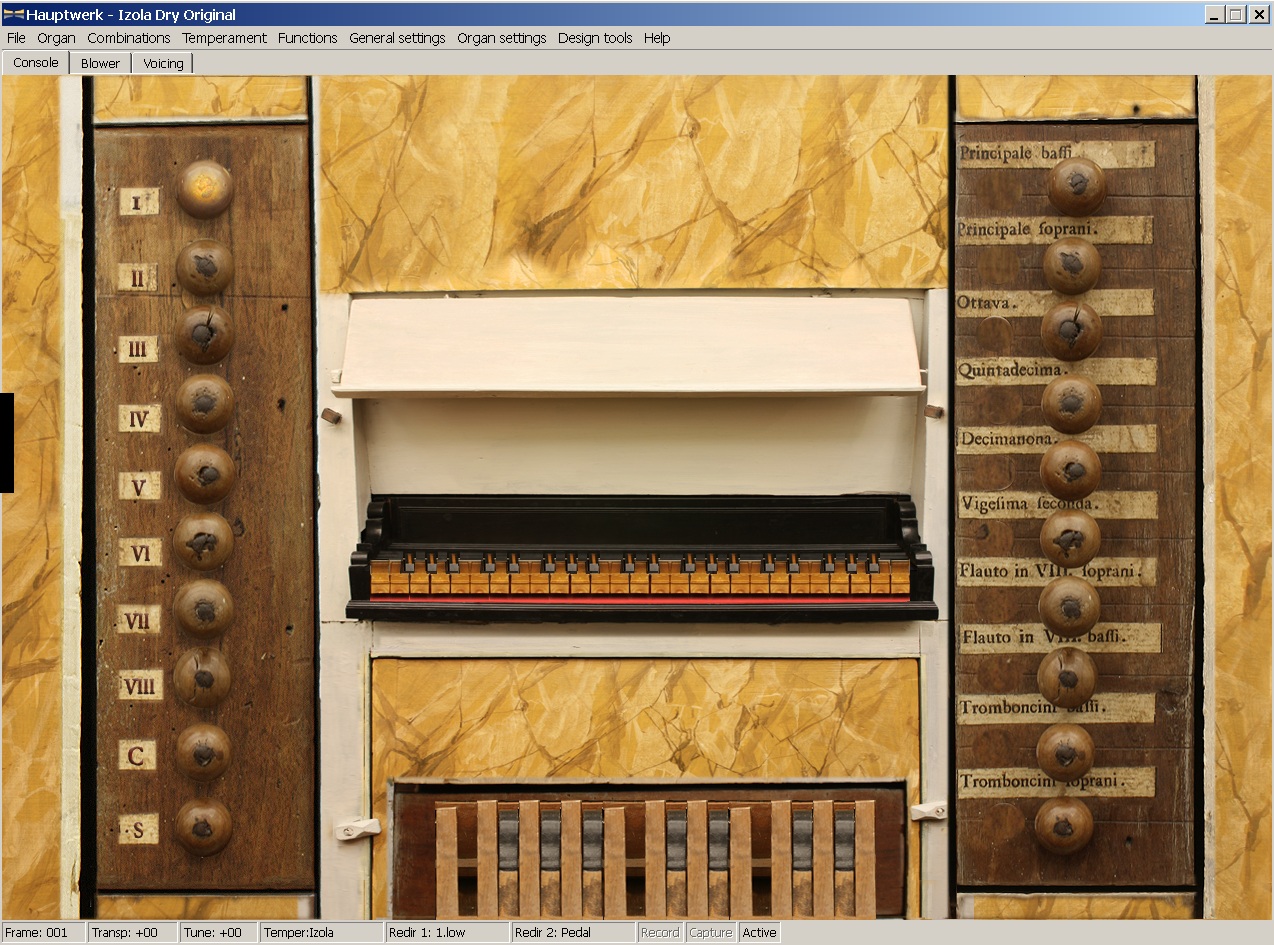
The sampleset is very simple to operate with the Console tab, there are two rows of buttons:
Left: 8 combination stops.
Right: (just like the real organ) the stops.
Personally, I find (especially in the beginning) awkward that the nameplates of the stops miss the 'feet name', for example 'Quintadecima' instead of 'Quintadecima 2 "'.
In other samplesets from Sonus Paradisi the menu 'Temperament / Original Organ Tuning' is blocked.
In this sampleset, they probably forgot.
This has the result that the highest three notes in the Extended Version have a bad pitch when you have chosen 'Original Organ Tuning'.
Choose always the 'Izola temperament' or 'Equal'.
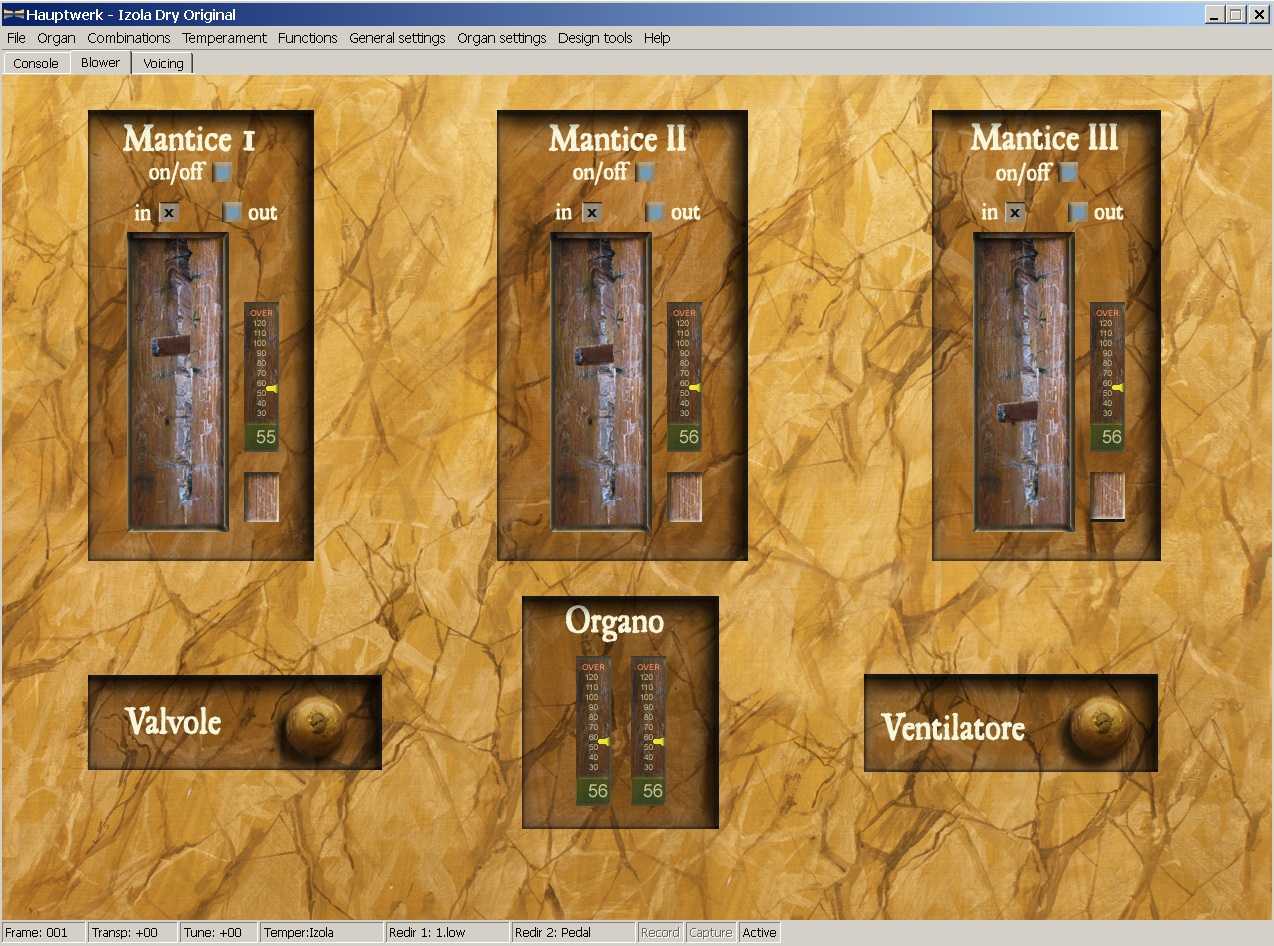
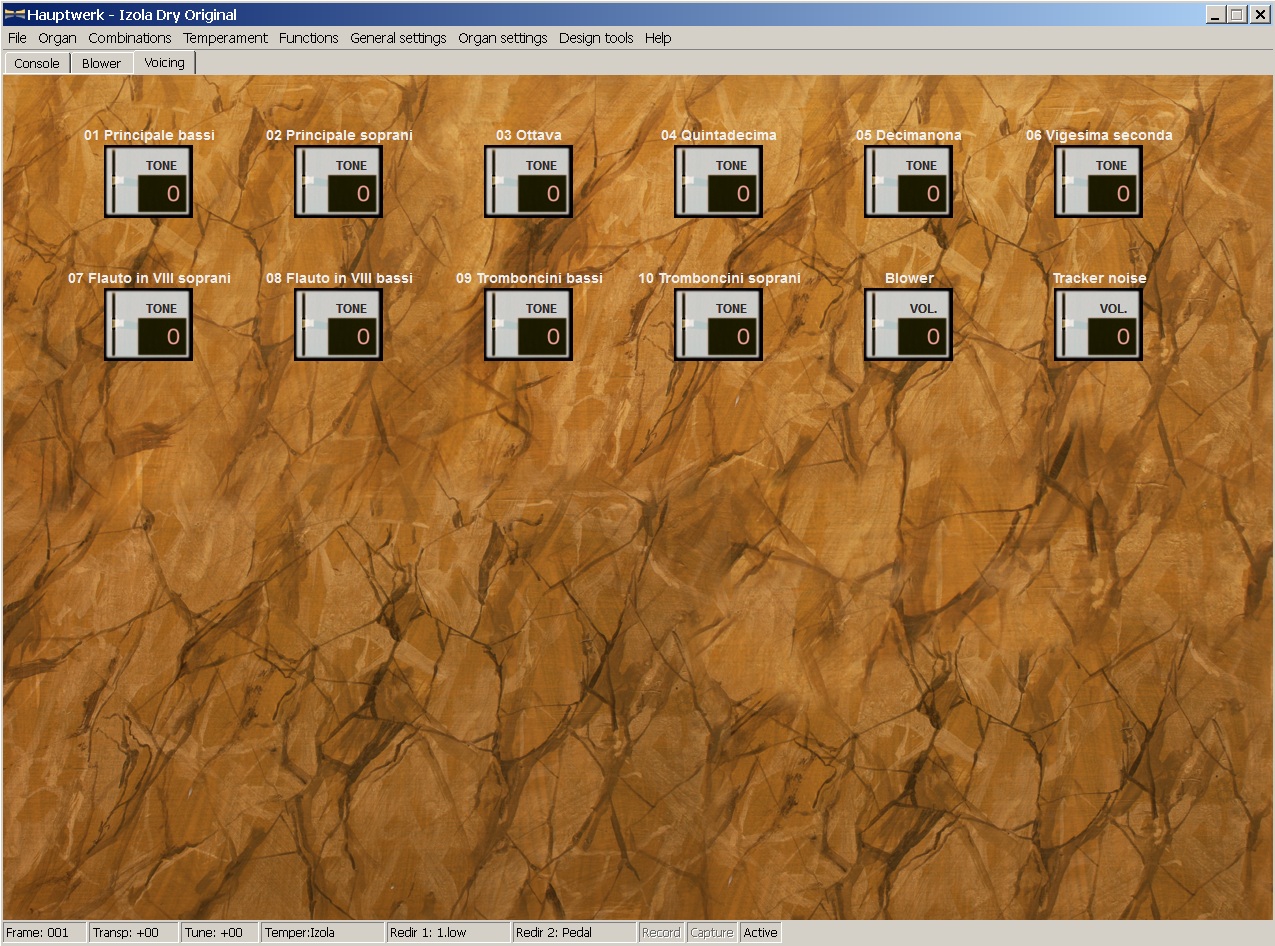
As with other Sonus Paradisi samplesets, there is also here a nice Windmodel tab and a Voicing tab (you can adjust the volume of wind engine (blower) and tracker noise).
Hauptwerk hobbyists who understand the Custom Organ Design Module (CODM), may benefit from this small organ to make an instrument with 2 keyboards (I am interested in a similar version).
The Wet-version can be loaded at 1143 MB (Standard memory reduction settings), a computer with 1.5 (or 2.0, depending on Operating System) GB of RAM is sufficient for this sampleset.
The Surround-version (2 stereo channels: front and rear) with 24-bit (top) quality takes 3.6 GB of RAM.
This sampleset is also available in a Dry version (closely recorded without reverb).
Other Dry-versions are always mono recorded.
Here is a new approach: There are three channels for each pipe, a stereo (left / right) channel, and a 'center' channel.
This has no major impact on the requirements: Even in 24-bit (top) quality is only 1.85 GB required for the Dry-version.
In the category of one keyboard organs, this is a gem because of its beautiful individual stops and great reverb.
Gert, juni 2010
Copy the file to c:\Hauptwerk\HauptwerkUserData\OrganCombinations\OrganID000822\
You can load the in Hauptwerk via menu 'Combinations\Load combinations file...'.